A desktop app for product managers
Become the PM that agents work for.
A native app where agents clear your admin, hold your context, and hand back the decision. Local by default.
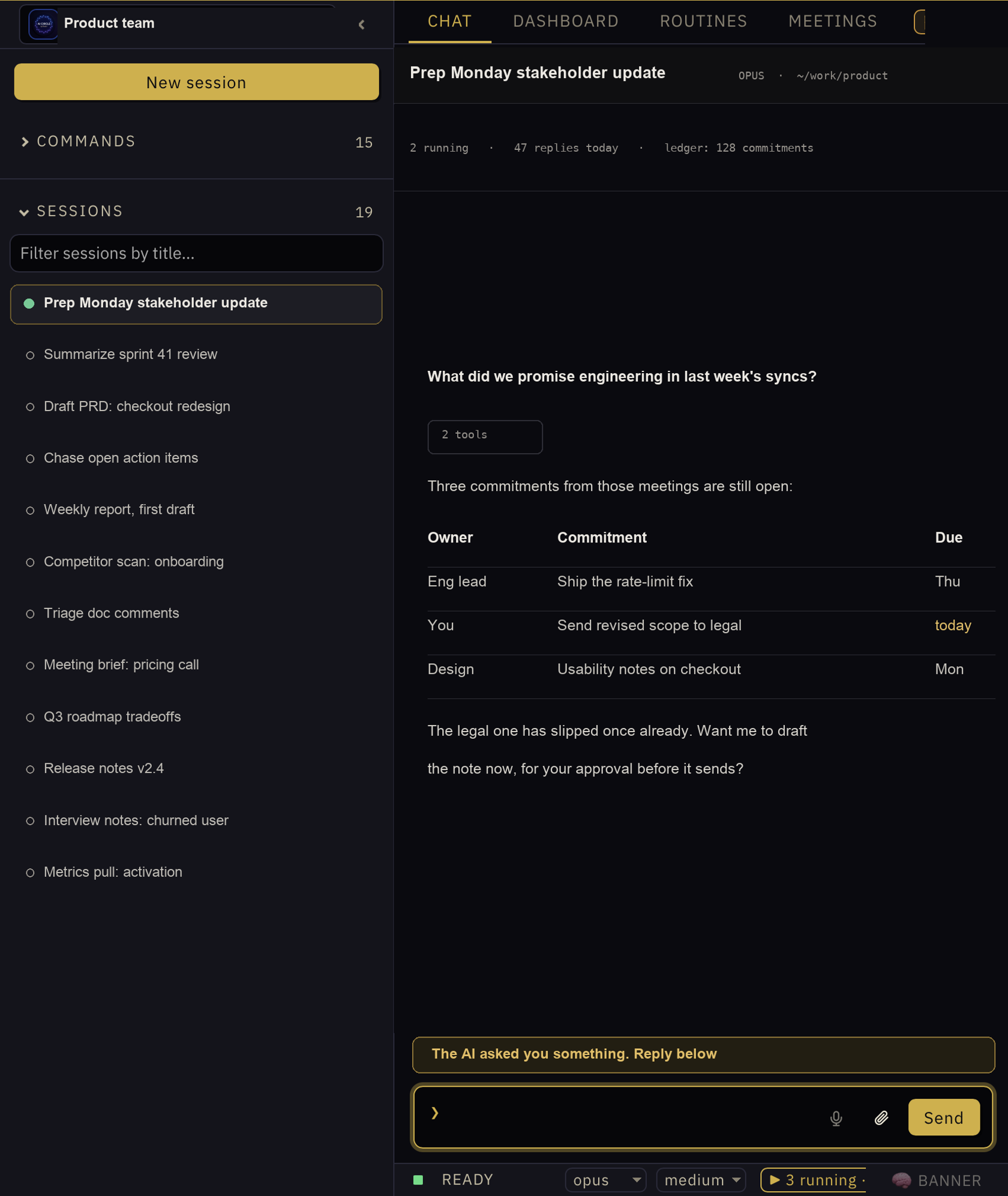
A desktop app for product managers
A native app where agents clear your admin, hold your context, and hand back the decision. Local by default.
 Zoom
Zoom MeetSlSlack
 Notion
 Jira
Jira Linear
 Docs
Docs Drive
Drive Calendar
 Gmail
Gmail Confluence
 GitHub
 FigmaFaFathomGrGranolaFiFirefliesZoomMeetSlSlackNotionJiraLinearDocsDriveCalendarGmailConfluenceGitHubFigma
It reads what these tools already produce and writes back where your team already looks. No migration, no new tracker, nothing for your team to adopt.
Nothing about your calendar changes. Everything about your morning does.
Without it
You start the archaeology. Scrub each recording, remember what was decided, copy the parts that matter, shape a narrative, chase two people who owe you an answer.
By noon you have a summary and no morning left.
With it
The update is drafted in your voice. The fourteen comments are triaged into three that need you. The two commitments that slipped last week are on one screen, with who owes what.
09:20 and you are arguing about the roadmap. Which was always the job.
Illustration of the shape of a day, not a measurement. No time-saving figure is claimed anywhere on this site.
Not features. The actual moments where the work goes sideways, and what changes in each one.
From archaeology to editing.
From recall to reference.
From post-mortem to prevention.
From blank page to first review.
From reading everything to deciding three things.
From reconstruction to review.
No time-saving figure is claimed here or anywhere else on this site. What changes is the shape of the work, not a number we have not measured.
Agents run on their own and watch things over time. Skills are things you invoke by name. Both read the same context file, so nothing ever starts from zero.
Keeps every promise as a history across meetings. Flags what slipped, what changed owner without a handover, and what quietly disappeared.
Records and transcribes on your own machine. No bot joins the call, and the audio never leaves your laptop.
Turns a week of meetings, threads and tickets into the update your stakeholders actually read, in your format and your voice.
Knows who owes you what and for how long. Drafts the nudge and waits. Nothing leaves without your approval.
Before every call, one card: what was decided last time, what is still open, and what this room owes you.
Every twenty minutes it reads the mail and chat you connected and pulls out the things that actually need you. Off until you switch it on.
Reads a shared document before it replaces it, so an edit somebody made while you were working does not quietly disappear.
Every meeting you feed it makes the others sharper. After six weeks it knows your team, your product, and what always slips. No setup interview.
Most tools charge you again for model access. This one plugs into your existing subscription, and there is a free path if you have none.
Your API keys are stored locally, shown masked, and never leave your machine. The app has no billing relationship with any model provider.
Every note taker on the market uploads your calls. If you work in fintech, health, or anywhere in Europe, that is the sentence your security review dies on.
Recordings, transcripts, the commitment ledger, your context file. All of it lives on your laptop, none of it on our servers. We do not have servers that hold your data.
Recording happens locally on your machine. Nothing joins the call, nothing announces itself, and external participants are never processed by a third party bot.
The app drives your own AI subscription. What gets sent to a model is what you choose to send, under keys you hold, on a bill you already control.
Your meetings never leave your machine. Neither should your mornings.
Get the app freePlenty of good tools write your PRD. None of them notice that the date you agreed to three weeks ago has quietly moved twice since.
| Agentic PM | ChatPRD | mySecond.ai | Note takers | |
|---|---|---|---|---|
| Shipped as | Desktop app, live today | Web chat | Plugin inside Claude Code | Web app and meeting bot |
| Extra subscription required | No, bring your own | Its own | Claude Code Pro | Its own |
| Records your meetings | Yes, on your machine | No | No | Yes, in the cloud |
| Writes the PRD and the update | Yes | Yes | Yes | No |
| Knows your product without being told again | Yes | Saved knowledge | Shared context | No |
| Tells you what quietly slipped since last time | Yes | No | No | No |
| Chases people so you do not have to | Yes | No | No | No |
| Your transcripts never leave your machine | Yes | Cloud | Local | Cloud |
| Price | 14-day trial, then $19/mo | Free, then $15/mo | $39/seat/mo plus Claude Code | Varies |
Checked August 2026 against each vendor's public pricing page. Category comparison, not a feature audit. Tell us if something is out of date and it gets corrected.
Free trial
$0
14 days · no card required
Pro · Founding
$9$19
per month, locked for life · first 100 people · yearly $90
Built by Brian Arfi
Two decades shipping product, currently a product director leading four teams at a loyalty platform in the Gulf. Before that, marketplaces and fintech used by hundreds of millions of people across Southeast Asia. He built this because four commitments went quiet in his own team's meetings, and he found them by hand, months too late.
Twenty three commands, eight agents and the commitment ledger, running today. Point it at the meetings you already have and the first report of what has slipped takes under a minute.
You are on the list.
Founding price is held against this address, and the download link is on its way. One email, and it has the build in it.
Read the docs while you wait